
 English
 Hindi
Hindi Marathi
 Urdu
Urdu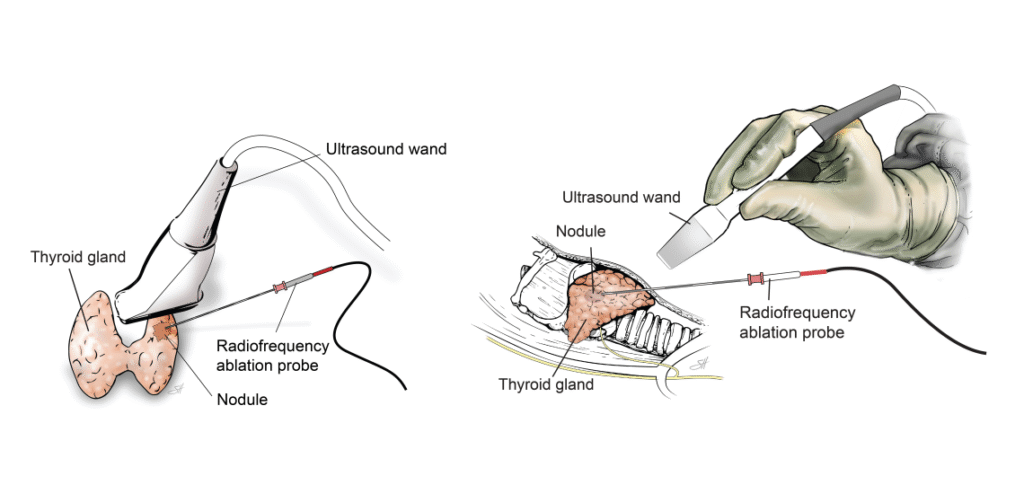
For decades, if you had a thyroid nodule that was growing too large or causing discomfort, the solution was almost always the same: conventional surgery. This meant a hospital stay, general anesthesia, a permanent scar on your neck, and often a lifetime of hormone replacement medication.
But the medical landscape has shifted. Today, Advanced Thermal Ablation—specifically Radiofrequency Ablation (RFA) and Microwave Ablation (MWA)—offers a “needle-only” alternative that is rapidly becoming a preferred treatment for benign thyroid nodules.
What is Thyroid Nodule Ablation?
Thyroid ablation is a minimally invasive, non-surgical procedure that uses thermal energy (heat) to shrink nodules from the inside out. Instead of making a surgical incision to remove part of the thyroid gland, a thin specialized needle is inserted through the skin under ultrasound guidance.
Once the needle is positioned inside the nodule, it emits heat energy that causes coagulative necrosis, meaning the abnormal tissue is destroyed. Over the next few months, the body’s immune system gradually absorbs the treated tissue, which results in significant shrinkage of the nodule.
Why Choose the “Needle” Over the Scalpel?
The shift from traditional surgery to needle-based treatment is not just about avoiding a scar—it also helps preserve thyroid function and improves recovery.
1. Preservation of Thyroid Function
In conventional surgery, doctors often remove half of the thyroid gland (hemithyroidectomy) or sometimes the entire gland. This may lead to hypothyroidism, requiring lifelong hormone medication.
Ablation Advantage:
RFA and MWA treat only the nodule, preserving the surrounding healthy thyroid tissue. This greatly reduces the chance of needing lifelong thyroid hormone tablets.
2. No General Anesthesia or Hospital Stay
Traditional surgery requires general anesthesia and usually a hospital stay.
Ablation Advantage:
Ablation is done under local anesthesia. Patients remain awake during the procedure and can usually go home within about an hour.
3. Scarless Treatment
Thyroid surgery often leaves a visible scar on the neck.
Ablation Advantage:
Since only a thin needle is used, there is no surgical incision. The entry point is tiny and usually disappears within a few days.
4. Faster Recovery
Surgical recovery can take 2–3 weeks, with activity restrictions and wound care.
Ablation Advantage:
Most patients can resume normal activities the next day.
Comparing the Options: At a Glance
| Feature | Conventional Surgery | Advanced Ablation (RFA / MWA) |
|---|---|---|
| Invasiveness | Highly invasive (incision) | Minimally invasive (needle) |
| Anesthesia | General anesthesia | Local anesthesia |
| Hospital Stay | 1–2 days | Same-day discharge |
| Scarring | Permanent neck scar | Minimal to none |
| Thyroid Function | May require lifelong medication | Usually preserved |
| Outcome | Complete removal of gland portion | 80–90% reduction in nodule size |
The Technology: RFA vs Microwave Ablation (MWA)
Radiofrequency Ablation (RFA)
RFA is the most widely used and studied method. It works by sending alternating electrical current through the needle, generating heat that precisely destroys the abnormal tissue. It is highly accurate and ideal for most benign thyroid nodules.
Microwave Ablation (MWA)
MWA uses microwave energy to heat and destroy the nodule. It can produce higher temperatures more quickly, which may make it useful for larger or highly vascular nodules.
Is Thyroid Ablation Right for You?
Ablation is particularly beneficial for benign (non-cancerous) thyroid nodules that cause:
- Neck swelling or cosmetic concerns
- Difficulty swallowing
- Breathing difficulty while lying down
- Pressure symptoms in the neck
However, surgery remains the standard treatment for thyroid cancers or suspicious nodules.
For many patients with benign thyroid nodules, minimally invasive ablation can effectively shrink the nodule while preserving normal thyroid function—often eliminating the need for long-term medication.
Considering Thyroid Nodule Ablation?
If you are exploring minimally invasive thyroid treatments, you may consult specialized centers that perform Radiofrequency Ablation (RFA), such as The Vascular Center by Dr. Amol Lahori at Century Hospital.
You can also discuss this option with your endocrinologist or thyroid specialist to understand whether this procedure is suitable for your specific condition.